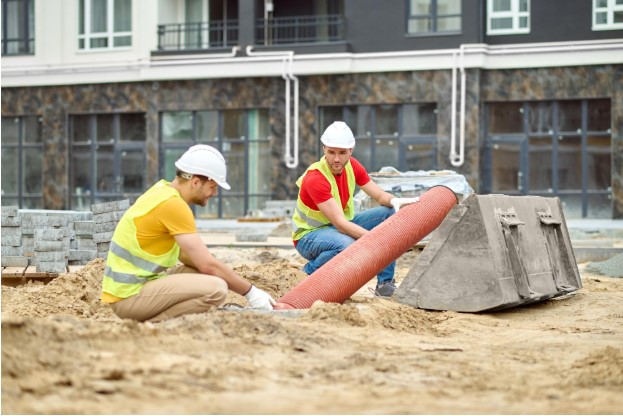
In modern construction and infrastructure development, excavation plays an important role in the installation of underground pipes and utilities. In this process, trenches or controlled pathways are constructed, making it easier to install and repair gas lines, electrical cables, drainage systems, and telecommunication networks.
Now, in modern cities, it has become highly important to properly excavate underground to avoid surface disruption and ensure the underground system functions properly. Let’s see how excavation is used in underground utility and pipelines.
Hydro Excavation
Hydro excavation, also called hydrovac or soft digging, helps expose the underground without damaging the surface. It’s a non-destructive method that outperforms a mechanical excavator and uses high-pressure water and powerful accumulators.
A specialized truck-mounted system uses high-pressure water to soften clay or hard soil. Then a suction pipe sucks the soft soil and fills it into the truck. By this process, the holes become clean, making pipes and cables visible.
Directional Boring
Directional boring is an advanced method to install underground pipelines and cables without drilling any holes. This technology is called trenchless technology because it makes ways below roads, or under buildings, without causing any harm.
A pilot hole is made by a specialized drilling ring that is entered from a specific angle, and it has a gps tracker that follows the right bore path, and then it exits from below at the other side. When the pilot hole is completed, pre-reaming is done, which enlarges the hole with the reamer.
Directional boring is used for roads, highways, railway tracks, and beneath rivers to install gas, water, or sewer lines. It avoids traffic blockage during installation, and you don’t need to ruin your beautiful lawn just to install a pipe.
Drainage System
A proper drainage system is important in any area to prevent stagnant water and soil settling during digging. It’s important to perform dewatering to prevent water from filling the trench.
Sump pumping is an easy way to avoid this problem. A sump is created in the lowest part of the excavation pit or trench. Water due to slope gets gathered in this sump, and then heavy-duty dewatering pumps sucks it out.
Other ways are deep well dewatering, in which, if the pipeline is extremely deep, more than 10 meters, then a well is dug around the excavation site, and submersible pumps are added to it. These pumps lower the water level in large amounts to keep the excavation area safe.
Leak Detection And Repair
It’s important to install a system that can easily detect any leakage underground. A sensor is used to detect sound through a microphone, which identifies gas and water leakage. A tracer gas, such as helium or hydrogen, is also used and added through a pipe. The gas rises where leakage occurs and can be detected by the sensor.
Hydrovac pressure is helpful in repairing these leaks. Pipe Clamping & Sleeving also secures pipelines and repairs leaks without digging the entire yard or site. It is a water-tight seal that stops leaks and cracks.