Construction is one of the most carbon intensive industries on the planet. The numbers are not ambiguous. According to the World Green Building Council, the construction and operation of buildings accounts for nearly 40 percent of global energy related carbon emissions. The built environment sector has known this for years, and the response has largely focused on what gets built rather than how it gets built. Green building certifications, energy efficient materials, and low carbon structural systems have all advanced significantly. The energy used during the construction process itself has received far less attention.
That is beginning to change. Regulatory pressure, investor expectations, and genuine shifts in contractor priorities are pushing the construction industry toward a serious reckoning with the emissions generated on active job sites. Diesel generators, which have powered construction sites for generations, are a significant contributor to those emissions. And the alternative that is emerging to replace them is not a compromise. It is a genuine upgrade in almost every practical dimension.
The Emissions Problem Nobody Measured
For most of construction history, job site emissions were not measured, not reported, and not factored into project sustainability assessments. Green building rating systems focused on the operational carbon of the finished structure. The diesel burned during construction was categorized as a temporary condition and largely ignored.
That accounting gap is closing. Major infrastructure clients, particularly in the public sector, are beginning to require scope three emissions reporting that includes construction phase energy use. Several European jurisdictions have already moved to restrict diesel generator use in urban construction zones. The trajectory is clear, and contractors who are not already building battery power capability into their operations are going to find themselves scrambling to comply with requirements that their better prepared competitors have already met.
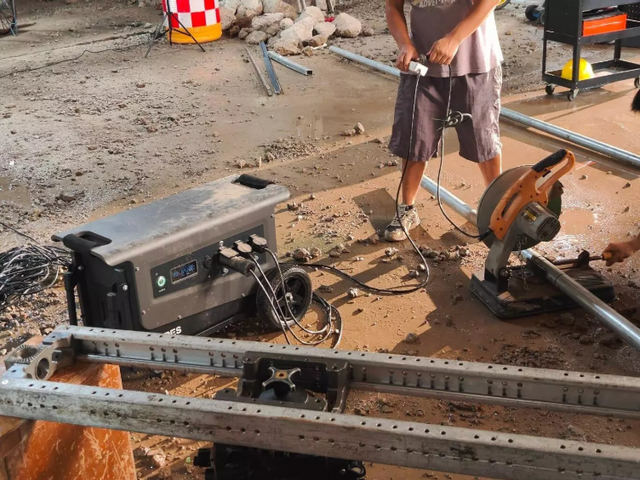
A portable Industrial Power Station running on lithium iron phosphate batteries produces zero direct emissions at the point of use. Charged from a grid connection, its lifecycle emissions are a fraction of an equivalent diesel generator even on a grid that still carries significant fossil fuel generation. Charged from solar panels, the emissions reduction against diesel approaches one hundred percent across the operating life of the system.
Solar Integration and the Path to Net Zero Job Sites
The concept of a net zero construction site sounds aspirational. In practice, the technology to get there is available today for a much wider range of project types than most contractors realize.
Solar panel arrays deployed on a construction site can generate meaningful power across a working day in most climates for most of the year. Paired with battery industrial power systems, that generation can be stored and deployed to match the load profile of a working crew rather than only being available when the sun is shining. Overnight charging from solar generation completes the cycle, and a site that starts each working day with fully charged systems that were replenished from renewable sources overnight has effectively decoupled its power supply from fossil fuels.
The economics of this approach have improved dramatically as solar panel costs have fallen. The capital cost of deploying a solar charging setup on a construction site of any meaningful duration is increasingly competitive with the fuel costs alone of an equivalent diesel generator operation, without accounting for the rental, maintenance, and logistics costs that accompany generator use.
Battery Systems and Green Building Certification
The construction industry’s sustainability credentials are increasingly scrutinized not just at the building level but at the process level. LEED, BREEAM, and other major green building certification frameworks are expanding their assessment of construction phase impacts. Contractors who can document the use of zero emission power systems during construction are in a stronger position when clients are making project award decisions on the basis of sustainability commitments.
This is not a future development. It is happening now in commercial real estate, public infrastructure, and large residential development where institutional clients have sustainability mandates that extend to their supply chains. An Industrial Power Station that produces no direct emissions is a documentable contribution to a project’s sustainability profile in a way that a diesel generator simply cannot be.
Material and Waste Reduction
Sustainable construction is not only about energy. Material waste, water consumption, and the environmental footprint of site operations all contribute to how a project performs against sustainability benchmarks. Battery industrial power systems contribute to this broader picture in ways that are less obvious than the direct emissions reduction but are nonetheless real.
Diesel fuel storage on construction sites carries contamination risk. Spills, leaks from aging equipment, and improper disposal of used fuel and oil are recurring sources of soil and groundwater contamination on construction sites. Battery systems carry none of this risk. There is no fuel to store, no used oil to dispose of, and no contamination exposure if equipment is damaged or overturned on site.
The maintenance consumables that diesel generators require, filters, belts, coolant, and engine oil, all have disposal implications that are eliminated when the equipment is replaced with battery systems. Over the life of a large project or a contractor’s fleet over multiple years, this reduction in maintenance waste is a measurable contribution to the overall environmental footprint of construction operations.
Workforce Health and the Overlooked Sustainability Dimension
Sustainable construction is increasingly being assessed through a social sustainability lens as well as an environmental one. Workforce health and safety is part of that picture. Diesel exhaust contains particulate matter and nitrogen oxides that have well-documented impacts on respiratory health, and construction workers who spend careers working in proximity to running generators carry elevated exposure compared to the general population.
Battery industrial power systems eliminate this exposure entirely at the point of use. For contractors who employ direct labor across multiple projects over many years, this is not a trivial consideration. It is a genuine improvement in the working environment that carries both ethical weight and practical implications for workforce retention in an industry that is already struggling with labor availability.
The future of sustainable construction runs on clean power. The equipment to deliver that power at the scale and reliability that serious construction work requires already exists. The contractors who recognize that and act on it now will be better positioned for the decade ahead than those who wait for regulation to force the transition.